When I sat in on the National DICE East session on Feb. 18, it became clear quickly that data center siting isn’t what it used to be. A process that once felt like straightforward site selection has evolved into a mix of community engagement, political strategy, and complex energy planning. Honestly, it’s a shift I’ve been expecting and one our industry needs.
What struck me most was how much the conversation centered on people rather than projects. After 3 decades of attending community meetings, from multifamily housing to mixed‑use developments to data centers. I’ve noticed the core concerns barely change. For residential projects: it’s about traffic, school capacity, affordable housing, road upgrades, tree canopies, parks, and light pollution. When the conversation shifts to data centers, the topics pivot but follow a familiar pattern: building massing, blocked views, job creation, noise from exterior HVAC banks, low‑frequency hums, ground vibration, water usage, rising power costs, or simply wanting land preserved as open space.
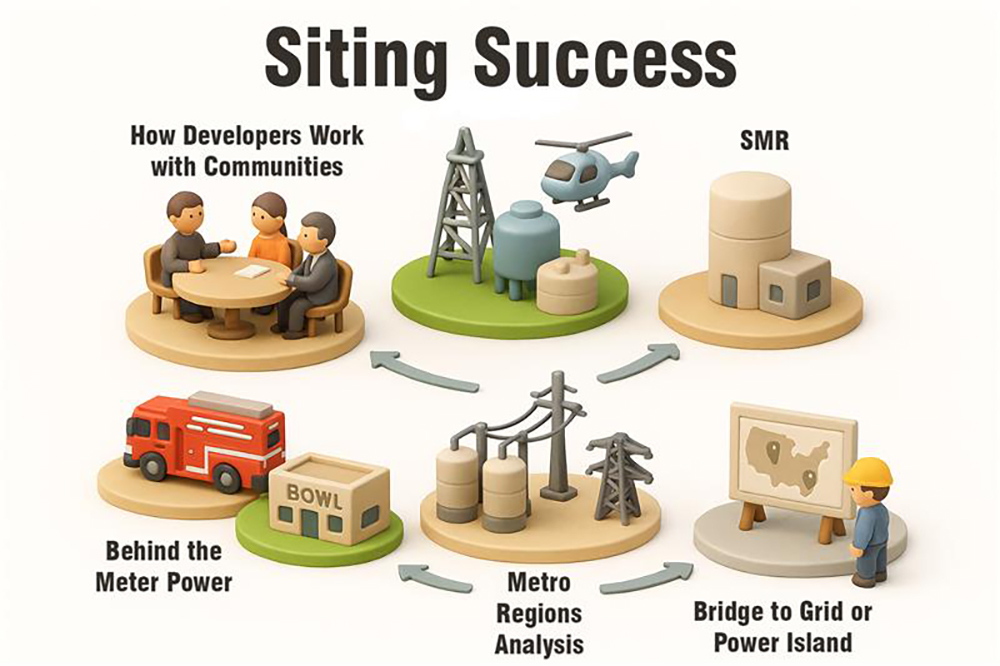
Developers at DICE East weren’t pretending these concerns don’t exist or trying to brush them aside with grand gestures, the old “fix up a bowling alley to win support” play. Sure, some of that still happens, and sometimes it’s genuinely needed; I’ve seen situations where a community’s only fire truck was on its last legs, and the team helped fund a replacement. But what the panel emphasized and what I’ve seen repeatedly is that the process matters far more than any single contribution. Open dialogue and simple education diffuse most concerns. When you take the time to demystify what a data center does, how it operates, and which impacts can be mitigated, neighbors become far less anxious and significantly more collaborative. If there’s one lesson decades of town halls have taught me, it’s that early listening can save a project long before any negotiation even begins.
Energy Strategy: The Story Behind Every Story
The conversation at DICE East kept circling back to one thing: energy. Not just how much we’ll need, but where it will come from, and how long it will take to secure it.
Behind‑the‑meter strategies came up repeatedly, especially in places like Pennsylvania’s Marcellus region, Texas, and Alberta -an approach increasingly tied to operators bringing their own power to meet stricter SLAs and high‑MW demand (consistent with PA’s “high impact data centers that have their own power” language in SB 939).
These strategies aren’t theoretical anymore. On one of our recent jobs, a several-hundred-acre data center campus, the developer planned to tap directly into a large natural gas main running along the property. The strategy was to deploy mobile gas turbine modules to power the first phases, then evolve into a full power island during later buildout. It was a new scale for us, essentially building a private generation backbone and utility‑fed power.
But that project underscored what the panel kept hammering home: interim generation isn’t a fringe solution anymore. With interconnection delays stretching into years, temporary turbines and hybrid generation strategies are becoming essential to delivering new capacity. A point reinforced by legislative discussions in Pennsylvania that increasingly encourage data centers to secure their own power sources (PA SB 939 amendment commentary).
The panel also looked ahead, pointing out that the industry will need far more small modular reactors (SMRs) than the handful currently in development to keep pace with future AI‑driven load growth -a sentiment echoed widely in energy policy circles.
The Myth of the “Power Czar”
A moment that drew some collective relief was when the panel dismissed the idea of creating a national “power czar” to coordinate all this. The reasoning was simple: the U.S. energy landscape is too regional, too fragmented, and too politically layered for one centralized authority to manage effectively. Markets and regional coordination may be messy, but they remain the most realistic path forward.
I agree -trying to centralize all of this would feel like directing traffic with a toothpick.
Labor, Policy, and the Bridge to Grid
Labor constraints surfaced as another key issue, especially in high‑growth markets like Texas, where development can outpace the skilled workforce. Meanwhile, states like West Virginia are moving toward by‑right data center construction, an approach like the streamlining efforts several states are now pursuing.
One of the most practical topics was the “bridge to grid” strategy, tools, and configurations that allow a project to progress while awaiting full utility interconnection. Between my experience with mobile turbines and the examples shared on stage, it’s clear that these interim strategies are no longer optional. They’re part of the new delivery model.
Policy Differences Across States: What I’m Seeing Lately
Another area where things are shifting fast is state‑level legislation. Until the panel brought it up, I wasn’t closely tracking Pennsylvania’s new activity. But since hearing about Senate Bill 939 and the 2026 regulatory proposals, I’ve dug deeper, and it’s clear Pennsylvania is becoming a model.
SB 939 establishes the Artificial Intelligence, Data Center, and Emerging Technology Regulatory Sandbox Program and includes provisions for permits for high‑impact data centers with their own power (PA SB 939). Early versions proposed fast‑track approvals, though 2026 amendments scaled back statewide overrides and emphasized respect for local decisions (PA Senate amendments Feb. 4, 2026).
What surprised me is how many other states are adopting similar ideas:
- New Jersey -S4293/A5548 requires data centers to submit water and energy usage reports to the NJ Board of Public Utilities (NJ S4293).
- Ohio -HB 525 regulates the use of AI in therapy and requires informed consent, setting early healthcare‑adjacent AI boundaries (OH HB 525).
- Florida -Gov. DeSantis’ proposed AI Bill of Rights includes parental controls, likeness protection, chatbot disclosure, and restrictions on AI‑based therapy (FL AI proposal); its legislative counterpart (SB 482) advanced through the Senate in 2026.
- Illinois -HB 4705 creates the AI Public Safety & Child Protection Transparency Act, requiring safety plans, public disclosure, and whistleblower protection (IL HB 4705).
- Illinois (again) -SB 3312 proposes the AI Safety Measures Act, regulating frontier AI development and requiring catastrophic‑risk safety frameworks (IL SB 3312).
Legislative trackers also show that Georgia, New York, and others are circulating bills modeled on NJ and PA’s transparency and reporting concepts (national state AI legislative updates).
To me, all of this connects back to patterns I’ve seen for years: policy friction isn’t disappearing, it’s just shifting levels. In places like Virginia’s Loudoun County, the tug‑of‑war between local control and the pressure to move quickly has shaped the entire data center ecosystem. Now, more states are stepping in to redefine those boundaries from the top down.
Looking ahead, I think we’re entering an era in which state policy will influence siting feasibility just as much as land costs or power availability. For those of us working in design and site strategy, that means tracking legislation and grid capacity in equal measure.
About the Author
Frederick is an award‑winning architect and planner with over 35 years of architectural design experience and nearly 20 years in the data center sector, bringing an international portfolio that spans large‑scale facilities and diverse project types. His background across global markets gives him a broad, practical lens that shapes the insights he shares.
Throughout this series, he closely follows the evolution of the data center market, drawing on industry events, newsletters, and ongoing dialogue with fellow experts to distill what’s worth paying attention to and why it matters.